Puglia rewards slow looking. Its drama is rarely announced by a single grand monument. It appears in the white glare of a hill town, laundry moving above a narrow street, fishing boats against turquoise water and ancient olive trees twisting out of red earth.
A landscape built from light
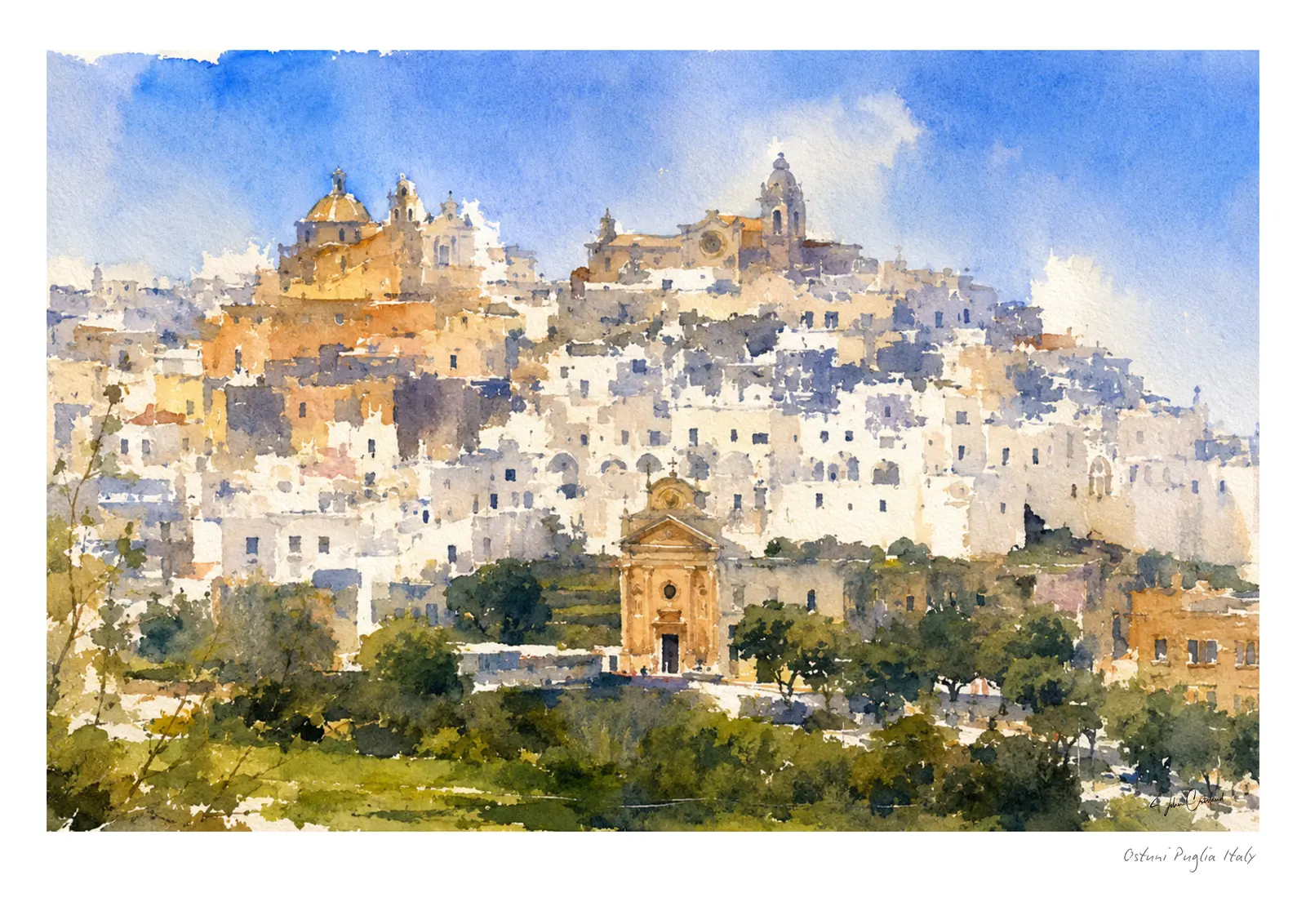
The first thing I remember is the brightness. Whitewashed buildings do not stay white for long in a painting: they pick up warm reflected colour, violet-grey shadows and flashes of blue from the sky. Leaving areas of untouched paper is often more convincing than covering everything with paint.
Across Ostuni, Locorotondo and Ceglie Messapica, the towns seem to rise naturally from the land. I use connected washes to keep those buildings together, then introduce only enough windows, domes and towers to give each place its identity.
Harbours, piazzas and everyday life
Monopoli and Gallipoli bring a different rhythm. Water breaks the solidity of the architecture and gives the colour somewhere to move. Boats, reflections and harbour walls can be suggested with a few marks, provided the larger shapes remain clear.
Inland, a piazza may be almost empty at midday and full of conversation by evening. I am interested in both versions: the still architecture under strong sun and the small human signs that show a place is lived in rather than preserved as scenery.
The trulli and olive country
Alberobello’s trulli are instantly recognisable, but repetition can make them feel decorative. I prefer to break the pattern with plants, uneven roof lines and lost edges so the buildings remain part of a real landscape.
Beyond the towns, olive groves and poppies soften the pale stone. These rural subjects let the brushwork become broader and less descriptive, which is often where watercolour begins to feel most alive.
A collection rather than a checklist
The Puglia paintings are not intended as a complete guide to the region. They are a record of the views that made me stop: a church facade, a blue door, an unexpected skyline or the particular colour of the sea beside an old wall.
Together they form a travel journal in paint. Each can be ordered as an archival fine-art print, while the wider collection allows several places to be grouped as a personal map of southern Italy.