
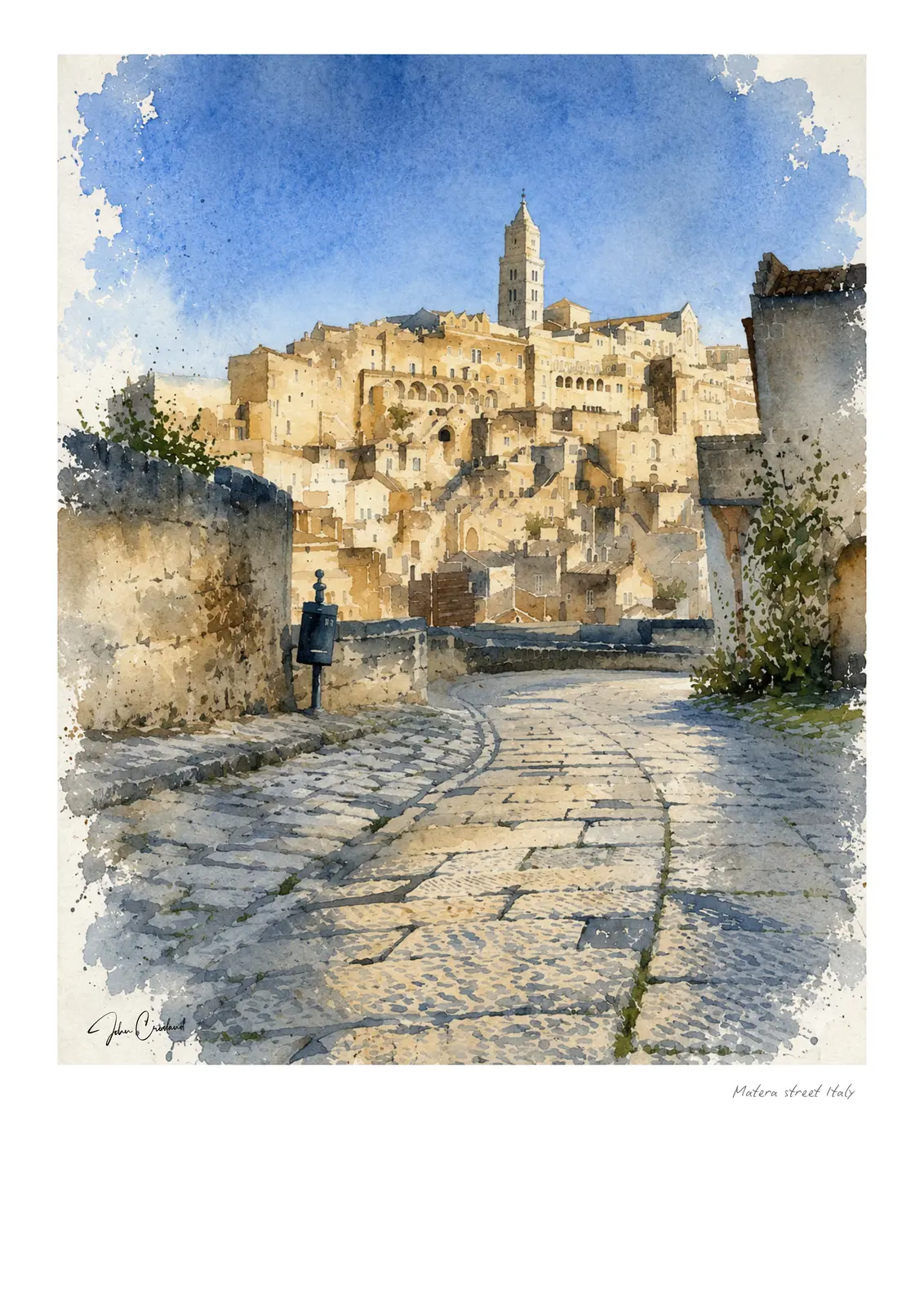
The grand view of Matera is unforgettable, but the city becomes more human when you turn away from the panorama. At street level it is made from steps, thresholds, worn walls and sudden openings where the landscape appears between buildings.
Walking changes the composition
Matera is rarely level. A lane becomes a roof, a staircase disappears beneath an arch and the same bell tower reappears from a completely different height. Walking through it continually rearranges foreground and distance.
I often photograph several versions of a view, but the final painting may combine what I noticed over a longer walk. It is less a single frozen second than a memory of moving through the city.
Painting the marks of time
Old stone contains an enormous amount of information. The temptation is to explain all of it. Instead, broken washes, dry brush and pigment settling into the paper can suggest age without turning the picture into a catalogue of masonry.
A clean edge beside a lost one is particularly useful. It allows one doorway or sunlit wall to come forward while the surrounding buildings dissolve into atmosphere.
People without portraiture
A small figure can establish the scale of a staircase or the height of an arch. I keep people loose because they belong to the movement of the place rather than becoming individual portraits.
Sometimes their absence is equally important. An empty lane under midday light has its own tension, as though the city has paused for a moment before life returns.
Why the smaller views matter
Panoramas show Matera’s extraordinary structure. Street paintings offer something quieter: the sensation of discovery and the feeling that another turn might reveal a completely different city.
Displayed together, a broad view and one close street scene create a more complete portrait. They work rather like a map and a memory placed side by side.