Locorotondo makes an impression twice: first as a pale shape on the hill, then as a collection of narrow streets and pitched roofs.
In the Valle d’Itria, it is easy to think of every white town as part of the same picture. Spend time looking and the differences become the point. Locorotondo has its own roofline, its own turns in the streets and a relationship with the surrounding countryside that changes as you move.
A skyline made of many small shapes
From outside the centre, the town gathers into a compact band of white and warm grey above the land. That distant view became Locorotondo Skyline. I was interested in the way individual buildings almost disappear into one shape, then return through a few changes of roof, window and shadow.
The local cummerse, houses with sloping stone roofs, help give the old centre a profile different from the conical trulli associated with nearby Alberobello. The distinction matters to a painter. A roofline is not just decoration; it sets the rhythm of the whole composition.
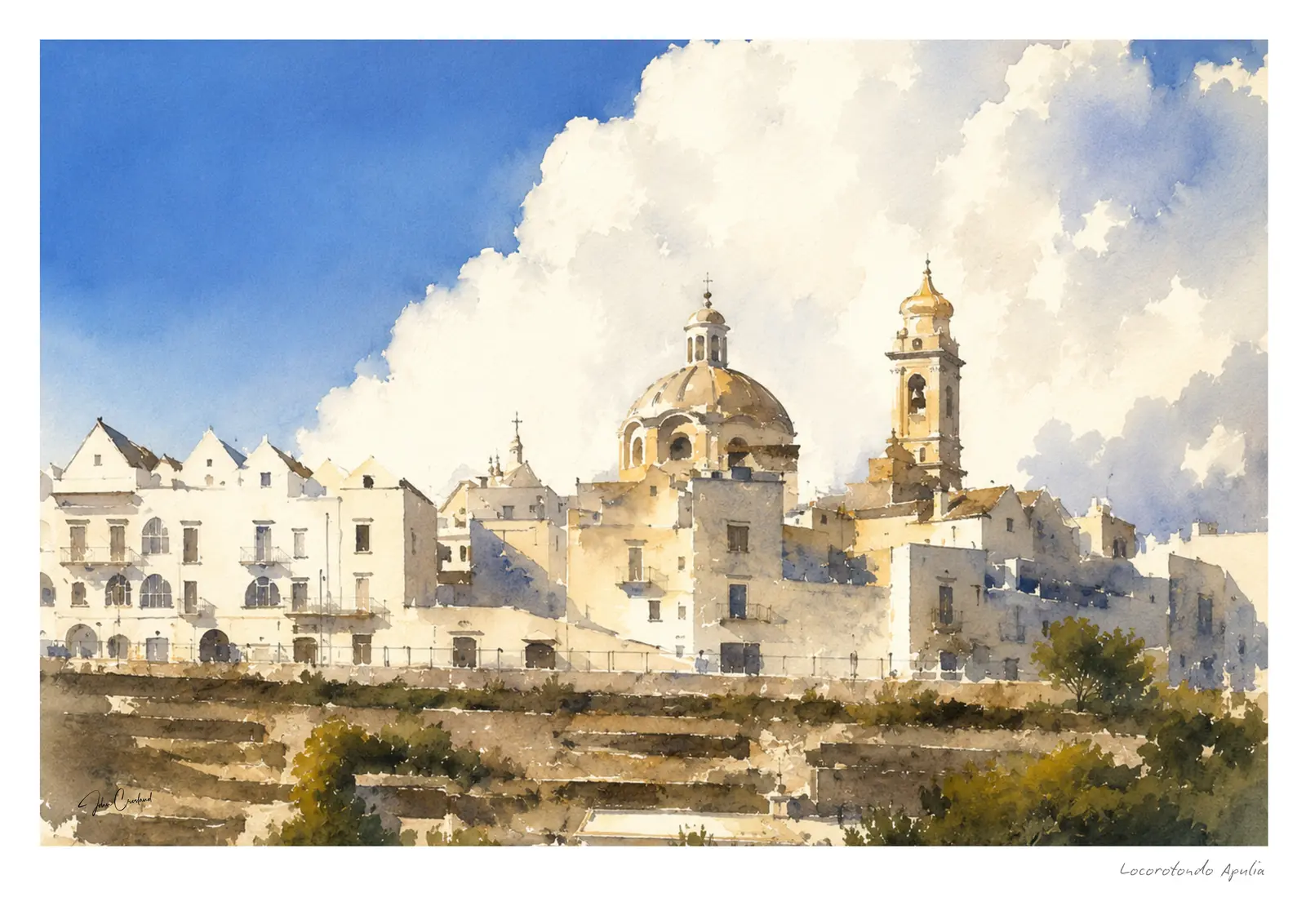
View Locorotondo Skyline and choose a print →
Walking from the view into the streets
Come into the centre and that broad shape breaks into limewashed walls, close passages and small glimpses of sky. A bright wall beside a shaded doorway can do more for a painting than a complicated landmark. The useful decision is often to leave the wall nearly untouched and let the shadow give it form.
The church of San Giorgio Martire offers another scale. Its architectural mass asks for a firmer arrangement of light and dark than the distant skyline. In the painting, I wanted it to remain part of the town, with enough detail to be recognised but enough looseness for the light to move through it.
Two distances, one place
The two works belong together because they ask different questions. What makes a town recognisable at a distance? And what remains when you are standing among its buildings? Watercolour lets me move between the two without treating either as a complete record.
There is a natural route from here to the trulli of Alberobello and the white streets of Ostuni. Their similarities are real, but so are their differences. Explore the Locorotondo paintings and the wider Puglia collection, or begin with A Painter’s Guide to Puglia.