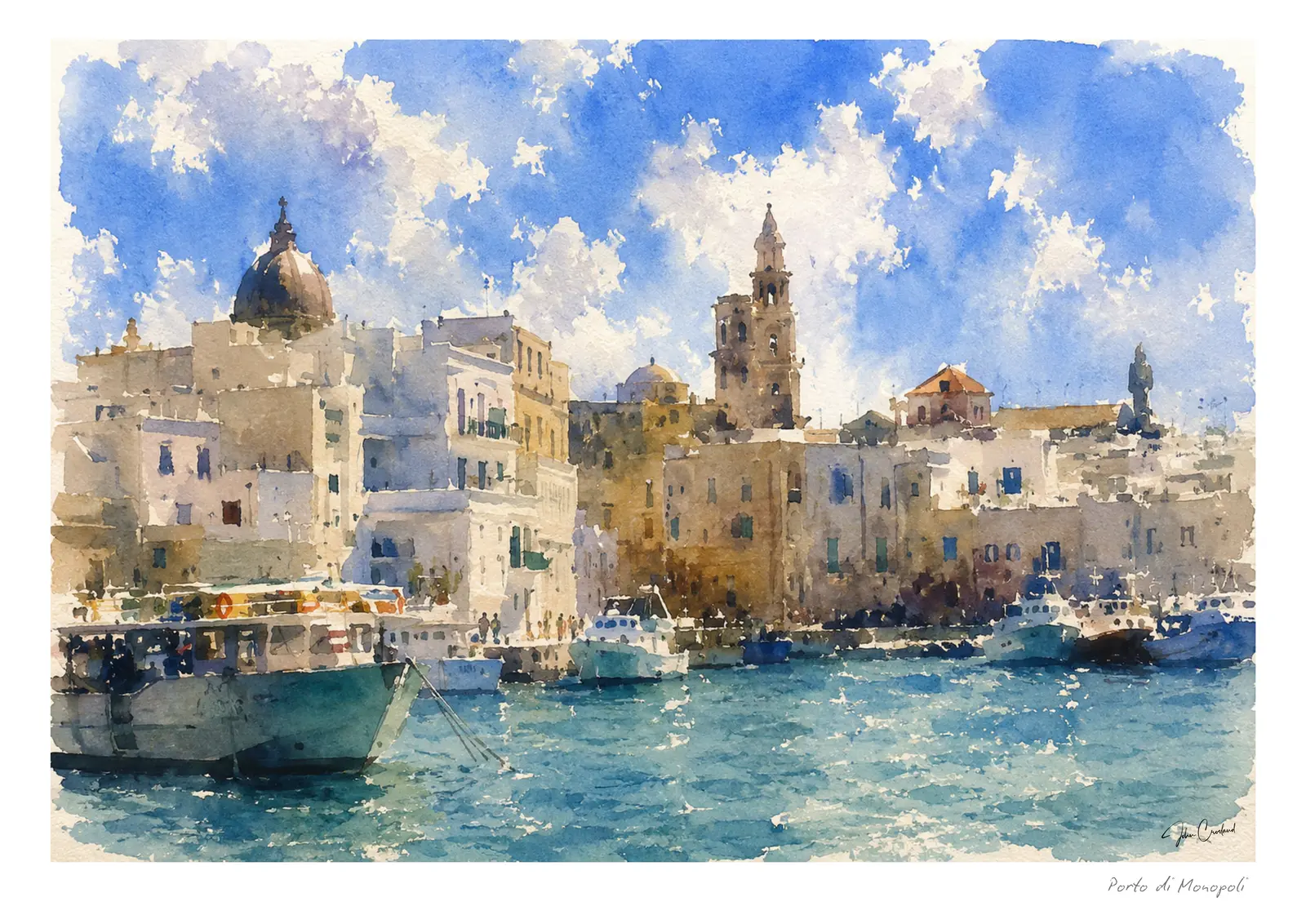
There is something about Puglia that seems made for watercolour.
Perhaps it is the light. Or the contrast between brilliant white stone and the deep blues of the Adriatic. Perhaps it is simply that nothing feels quite too perfect. Walls are weathered, shutters fade in the sun and old streets wander off at unexpected angles.
For a painter, that’s where things become interesting.
Painting the light of southern Italy
The light in Puglia can be extraordinarily strong. By the middle of the day, pale limestone buildings seem almost bleached by the sun, while doorways and narrow alleys fall into deep shadow.
Watercolour responds beautifully to this.
Rather than painting every window, stone or roof tile, I find myself looking for the larger shapes: a sunlit wall against a cobalt sky, the cool shadow beneath an archway, or a splash of colour from flowers against old stone.
Sometimes what you leave unpainted becomes as important as the paint itself.
Monopoli and the Adriatic
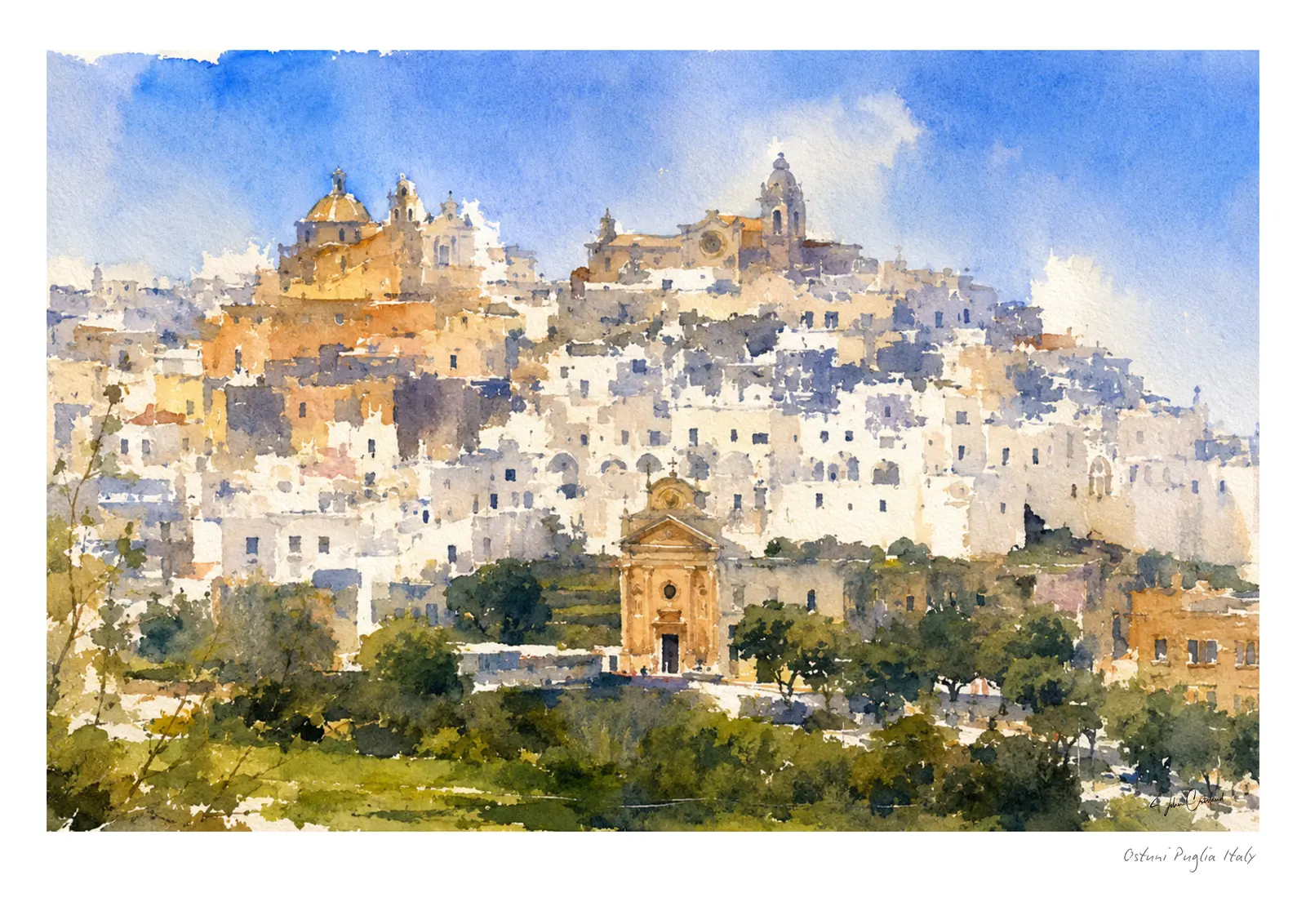
Monopoli is one of those places where it’s difficult to walk very far without seeing another possible painting.
The old town reaches towards the sea in a maze of pale buildings, small piazzas and narrow streets. Then suddenly a street opens and there is the Adriatic.
Around Porto Antico, the small blue fishing boats bring another layer of colour to an already wonderful scene.
But what interests me most isn’t necessarily the obvious postcard view. It might be the side of a building catching the afternoon sun, laundry moving above a narrow street, or a glimpse of intensely blue water between two pale walls.
These smaller moments often make the paintings I like most.
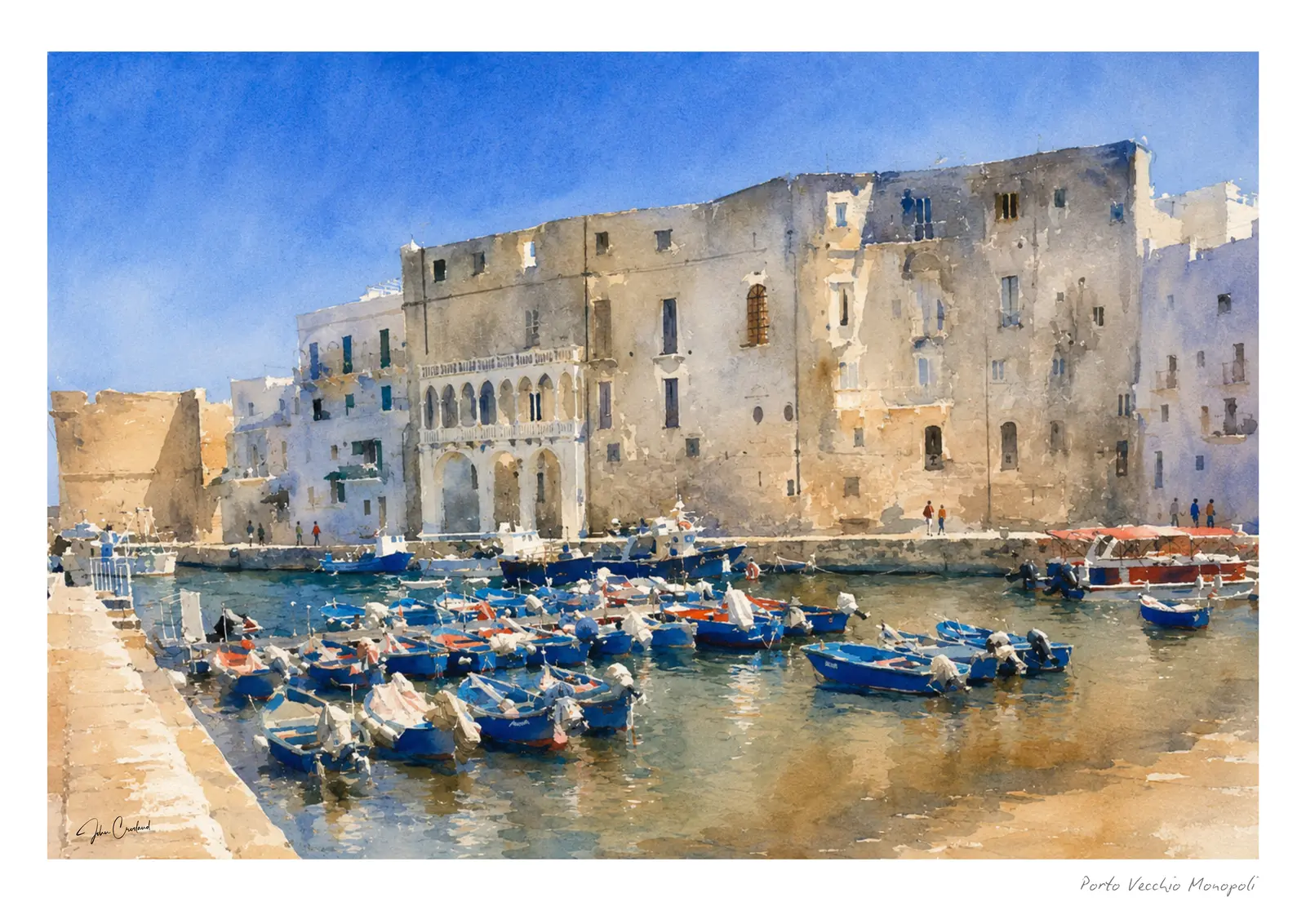
View Monopoli Seafront and choose a print →
The stone landscapes of Puglia
Move inland and the character changes.
Olive trees, dry-stone walls and warm earth begin to replace the blues of the coast. Towns rise almost organically from the landscape, their stone buildings taking on different colours as the light changes.
And then there is Matera.
Technically just across the border in Basilicata, Matera feels like a natural continuation of a journey through this part of southern Italy.
It is an extraordinary place to paint.
The city folds around its ravines and climbs over itself, with roofs becoming streets and buildings appearing to grow directly from the rock. From a distance it can seem almost monochrome.
Look for a little longer and the colours begin to appear: warm ochres, dusty pinks, violet shadows and flashes of blue-grey.
Watercolour seems particularly suited to it because the medium doesn’t demand that everything is explained.
A wash can suggest an entire group of buildings. A broken edge can become an ancient wall. Pigment allowed to run into damp paper can sometimes describe weathered stone more convincingly than carefully painting every detail.
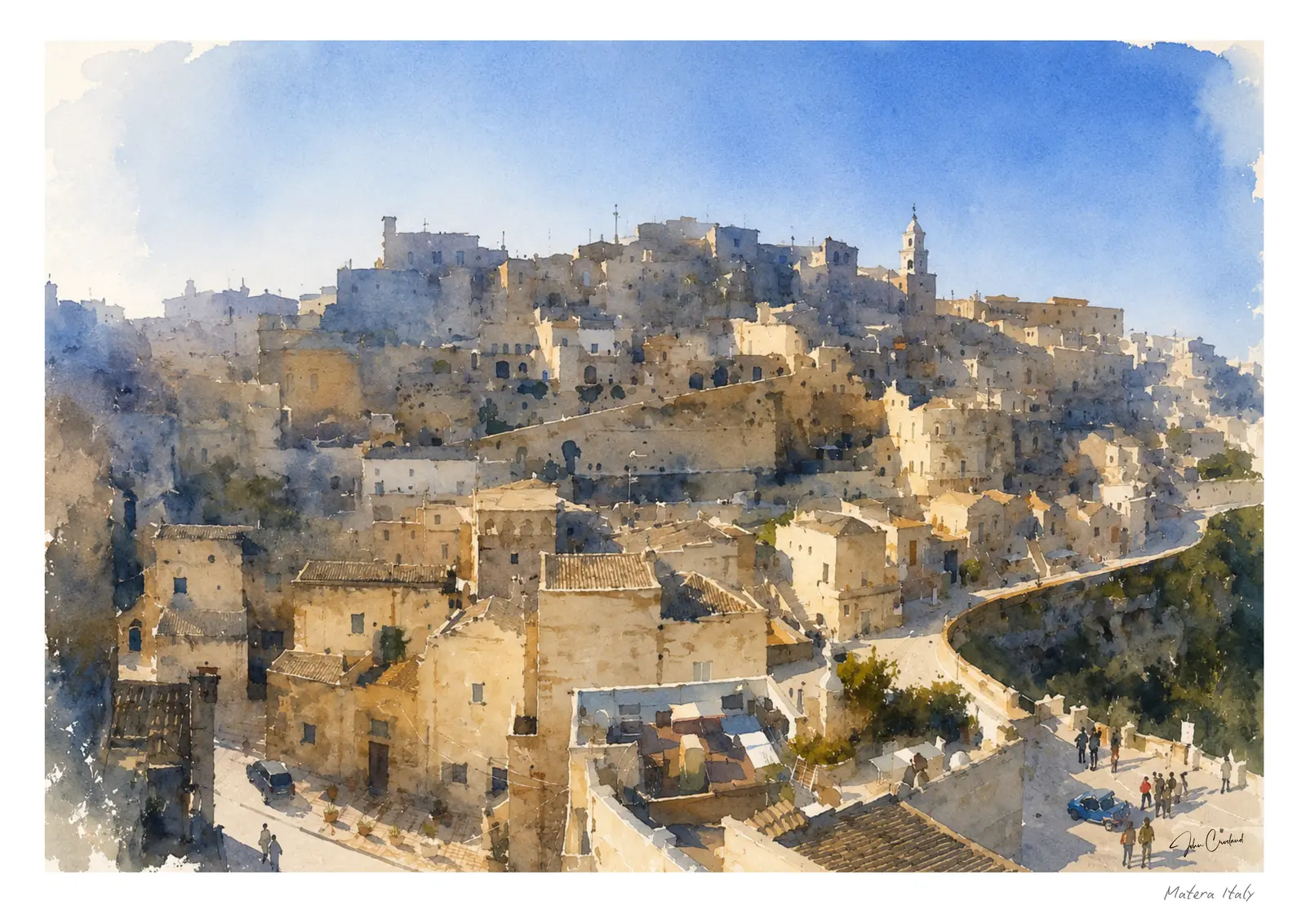
View Matera, Ancient City and choose a print →
Painting less
Travelling with a painter’s eye changes the way you look at places.
You begin noticing shadows on walls, reflections in harbours and the colour of distant hills. You also realise that the scene in front of you contains far more information than a painting actually needs.
One of the things I increasingly enjoy about watercolour is deciding what to leave out.
I want the paintings to retain the feeling of the place without becoming illustrations of it. A doorway might disappear into a wash. A building may simply dissolve into the paper. People can be suggested with a few marks rather than carefully described.
The viewer finishes some of the painting themselves.
And perhaps that’s part of what gives watercolour its life.
A continuing journey
The Watercolour Atlas began from this connection between painting and place.
Puglia is an important part of that journey, but the Atlas will continue to grow through other cities, coastlines and landscapes encountered along the way.
Some will be familiar. Others may be places you haven’t thought about visiting before.
That’s part of the pleasure.
A painting can be a record of somewhere we have travelled, somewhere we remember, or sometimes simply somewhere we would like to be.
And in Puglia, there always seems to be another street, another harbour and another patch of Mediterranean light waiting around the corner.
Explore the Puglia and Italian watercolour collection in The Watercolour Atlas.