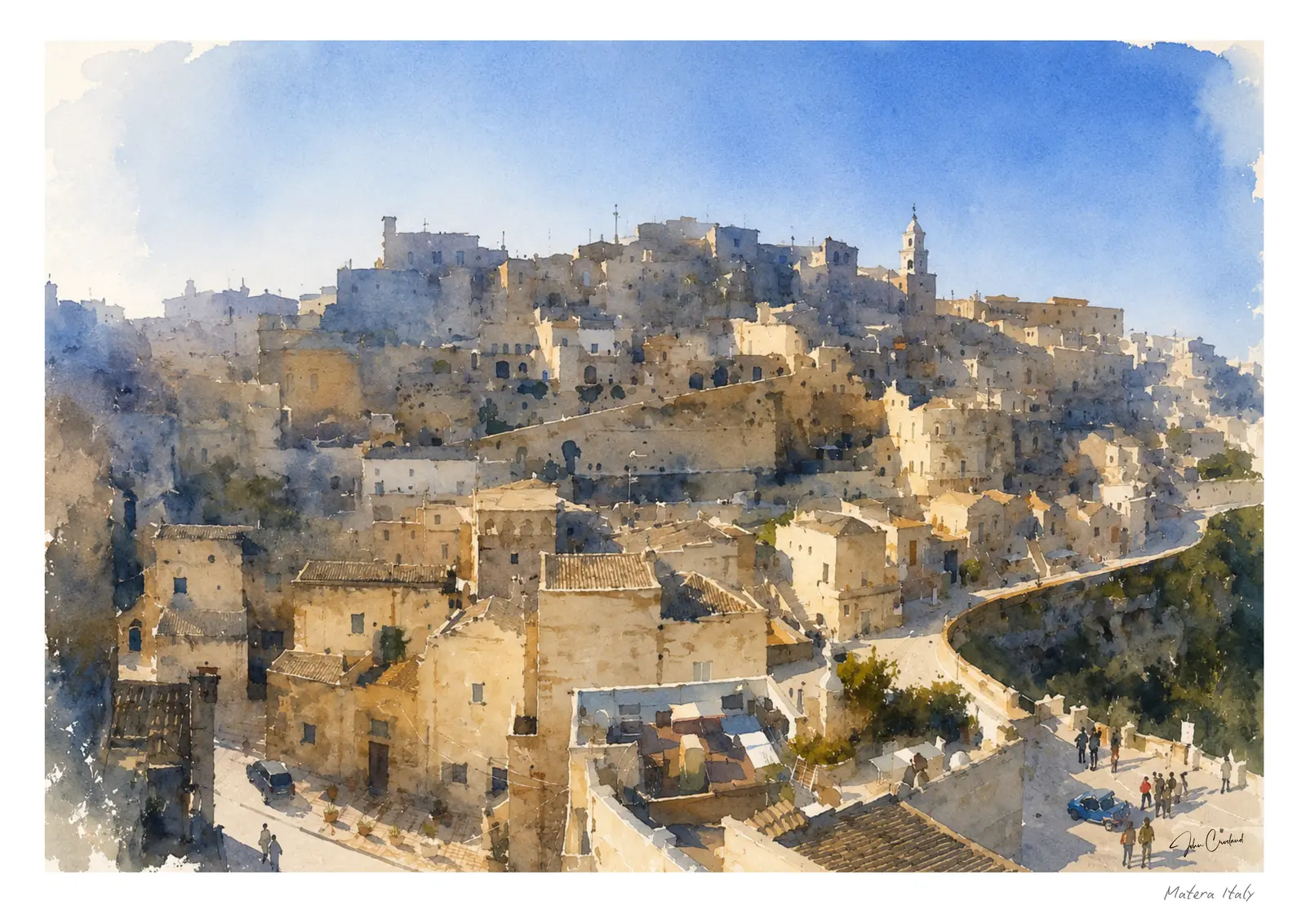
Matera does not reveal itself in a single view. The city folds around ravines and climbs over itself, pale stone catching the sun while alleys disappear into shadow. For a watercolour painter, it is both irresistible and slightly daunting.
Why Matera keeps calling me back
I first respond to atmosphere rather than architectural detail. In Matera, that atmosphere comes from the relationship between the honey-coloured stone, the enormous southern sky and the dark cuts made by doorways, arches and gullies. A photograph can record every building. A painting has to decide what the place felt like.
That is why Matera has become a series rather than one definitive picture. From across the Gravina the city feels monumental. Closer in, it becomes a collection of fragments: a bell tower, a sunlit wall, steps worn smooth and a glimpse of landscape between buildings.
Finding a composition in the Sassi
The difficulty is knowing what to leave out. Matera is visually dense, and trying to describe every window can flatten the very thing that makes it exciting. I look for one strong route through the image, often a road, wall or line of rooftops, then allow the smaller forms to merge into connected washes.
The distant buildings are usually quieter and cooler. Warmer ochres and sharper darks come forward. That simple shift creates depth without drawing every stone, and it leaves enough open paper for the painting to breathe.
Watercolour, light and old stone
Watercolour suits Matera because it can be solid and transparent at once. Granulating pigment suggests the broken surface of limestone, while clear washes keep the sensation of heat and light. The most useful marks are sometimes accidents: a bloom that resembles weathered plaster or two colours meeting at the edge of a shadow.
I try not to tidy those moments away. The goal is not a polished architectural rendering. It is a memory of standing there, looking across a city that seems to have grown directly from the rock.
From travel journal to fine-art print
The finished Matera paintings retain the irregular paper edges, handwritten place notes and signature of the originals. Those details matter. They make the print feel connected to a particular journey rather than detached from the sketchbook that produced it.
Each work is available as a made-to-order fine-art print from A4 to A1, either as the print alone, mounted, or mounted and framed. The larger landscape formats work particularly well for the wide city views, where the layers of stone and distance have room to unfold.