There are places that announce themselves immediately, and others that reveal themselves slowly.
Monopoli does a little of both.
At first, it is the light that catches you. Whitewashed buildings sit beneath an enormous southern Italian sky, while just beyond the old town the Adriatic seems impossibly blue.
Then you start walking.
The streets narrow, washing hangs between balconies, small shrines appear in unexpected corners and glimpses of the sea flash between pale stone buildings.
For a watercolour painter, it is difficult to know where to look first.
Porto Antico
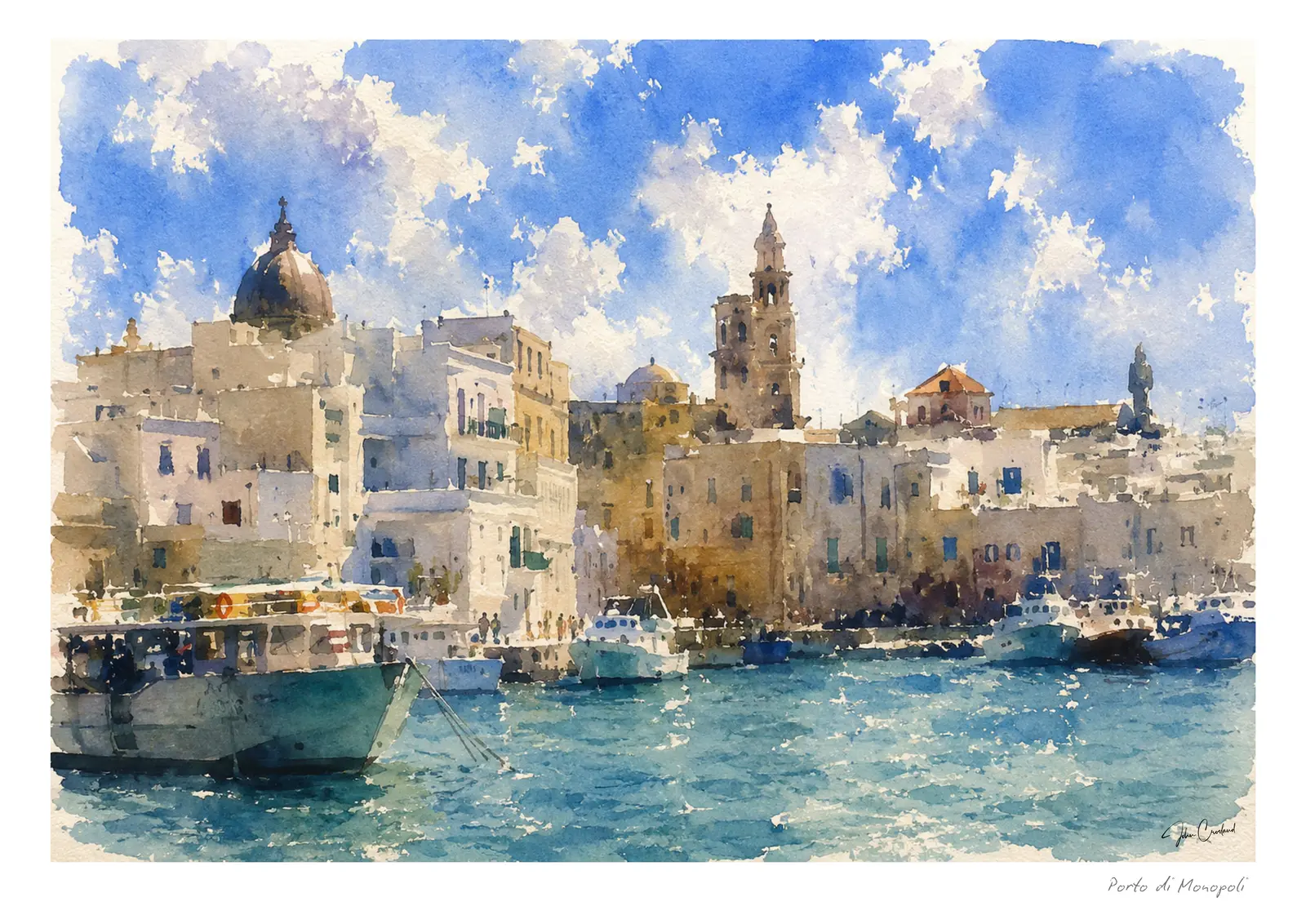
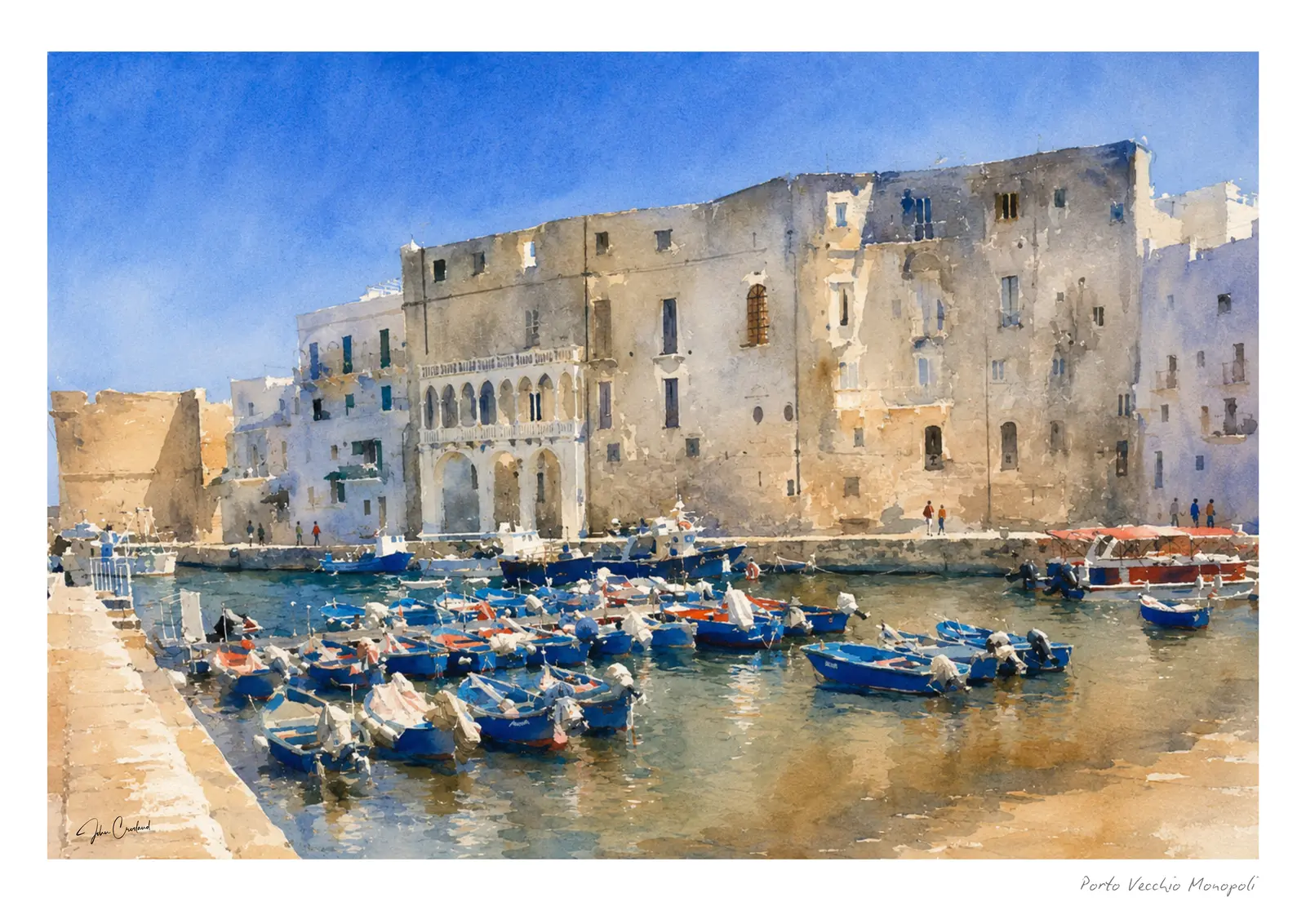
The old harbour, Porto Antico, is perhaps the image of Monopoli that most people recognise.
Small blue fishing boats float against the harbour walls while fishermen come and go much as they have for generations. Behind them rises the pale jumble of the old town.
It would be very easy to paint the scene exactly as it appears.
But that’s rarely what interests me most.
What catches my eye is the contrast: brilliant sunlight against deep shadow, the almost electric blue of a boat against warm stone, reflections broken by the movement of the water.
In watercolour, those contrasts can become more important than the detail.
A few loose marks can suggest a boat. A wash of blue-grey becomes a reflection. Parts of a building can simply disappear into the light.
The painting doesn’t need to describe everything.
Wandering through the old town
Leave the harbour and Monopoli becomes a maze.
The historic centre is full of narrow streets that twist between white and honey-coloured buildings. Some suddenly open into little piazzas. Others lead beneath archways or towards churches that seem almost too grand for the tiny streets surrounding them.
And every so often, at the end of an alley, there is the sea.
These are often the scenes I find myself wanting to paint.
Not necessarily the famous viewpoint, but a doorway in shadow. A sunlit balcony. A plant spilling over an old wall. A figure disappearing around a corner.
Watercolour suits these fleeting moments.
You don’t have to explain the whole street. Sometimes a few shapes, shadows and colours are enough to bring back the feeling of being there.
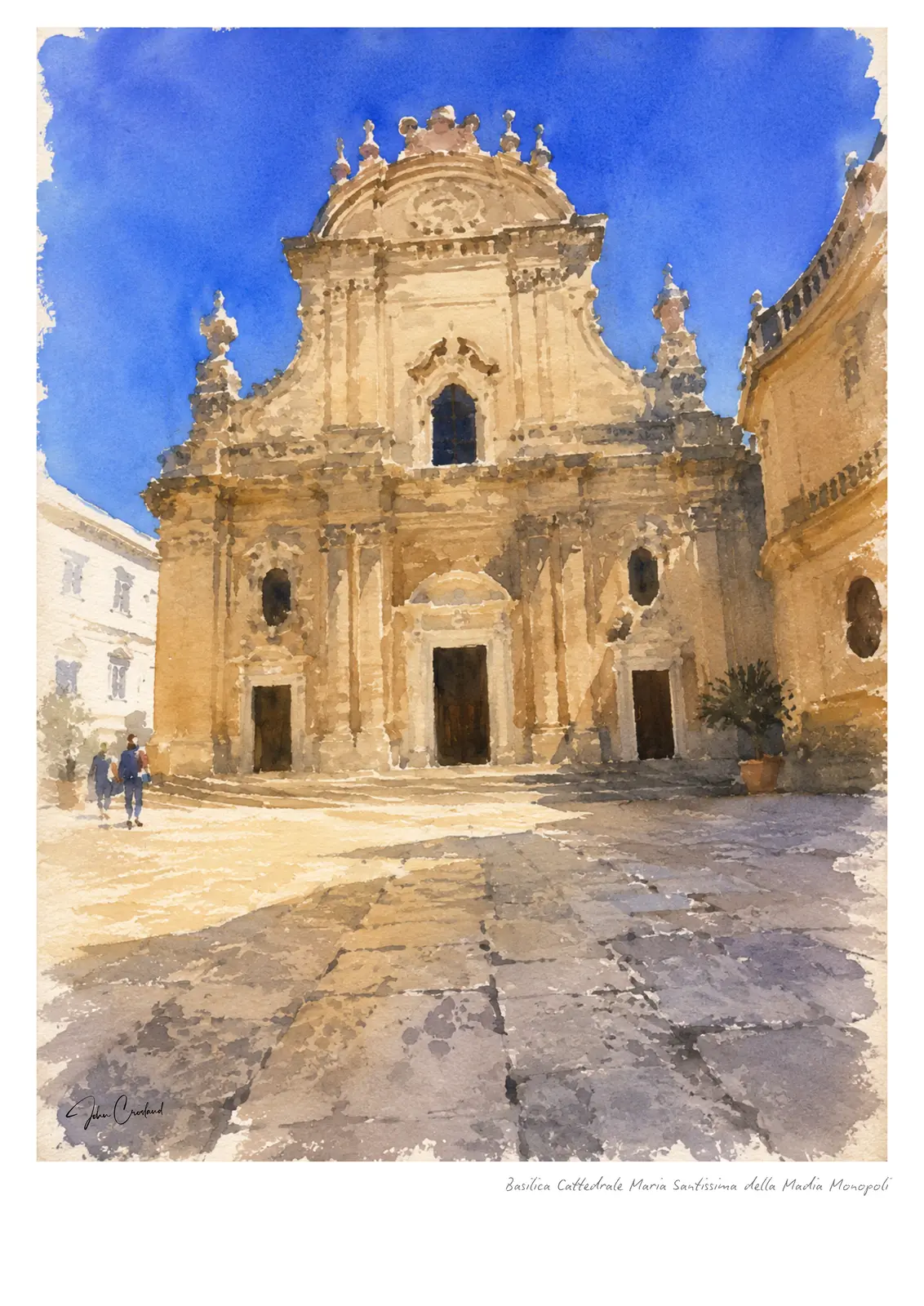
View Monopoli Cathedral and choose a print →
The colours of Monopoli
People often think of southern Italy as intensely colourful.
Monopoli is, but perhaps not in the obvious way.
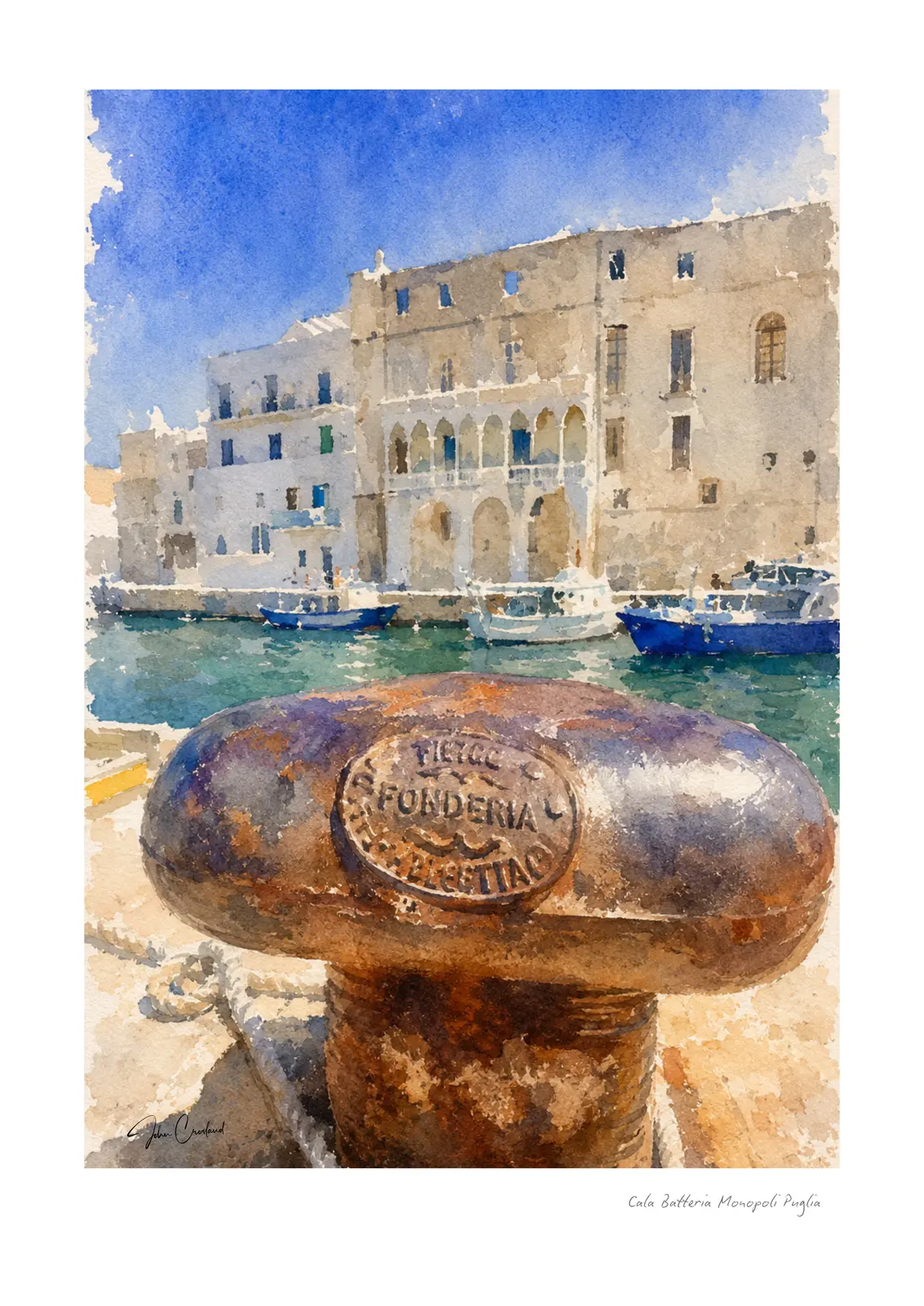
Much of the old town is surprisingly restrained: limestone, faded plaster, warm cream and pale grey. Against this quiet background, small areas of colour suddenly become extraordinarily powerful.
A cobalt sky.
A turquoise shutter.
Terracotta pots.
The blue of a fishing boat.
Bougainvillea spilling across a white wall.
And, of course, the Adriatic.
As a painter, this makes Monopoli fascinating. You don’t need colour everywhere. In fact, the quieter areas allow those few stronger colours to sing.
Where the town meets the Adriatic
One of the pleasures of Monopoli is how closely the old town and the sea are connected.
Walk along the waterfront and ancient walls seem to rise almost directly from the Adriatic. Turn inland and within moments you are back among narrow streets, balconies and little squares.
There are beaches tucked remarkably close to the historic centre too, another reminder that Monopoli isn’t simply a beautiful old town preserved for visitors.
It is a place where people live alongside the sea.
That relationship between architecture, water and light is probably what keeps drawing me back to it as a subject.
View Monopoli Seafront and choose a print →
Painting the feeling rather than the view
A photograph records an enormous amount of information.
A painting doesn’t have to.
When I paint a place like Monopoli, I’m increasingly interested in removing things rather than adding them.
Windows can become a few marks.
Boats can merge into reflections.
The edge of a building might dissolve completely into the paper.
Sometimes the white of the paper itself becomes the brightest Mediterranean sunlight.
This is one of the things I love about watercolour. It allows a place to remain slightly unfinished.
The viewer fills in what isn’t there.
And somehow that can feel closer to a memory than a perfectly detailed image ever could.
Part of The Watercolour Atlas
Monopoli has become an important part of The Watercolour Atlas because it captures so much of what first inspired the project.
Travel. Light. Architecture. Water. And those small, easily missed moments that make somewhere memorable.
The Atlas will eventually travel much further, through different cities, countries and landscapes.
But Monopoli feels like a natural place to begin.
Perhaps because it contains so many of the things I love to paint.
Old stone warmed by the sun, deep shadows beneath archways, boats moving gently in a harbour and, never very far away, that extraordinary blue line of the Adriatic.
Explore the Monopoli watercolour collection and the wider Puglia collection at The Watercolour Atlas.